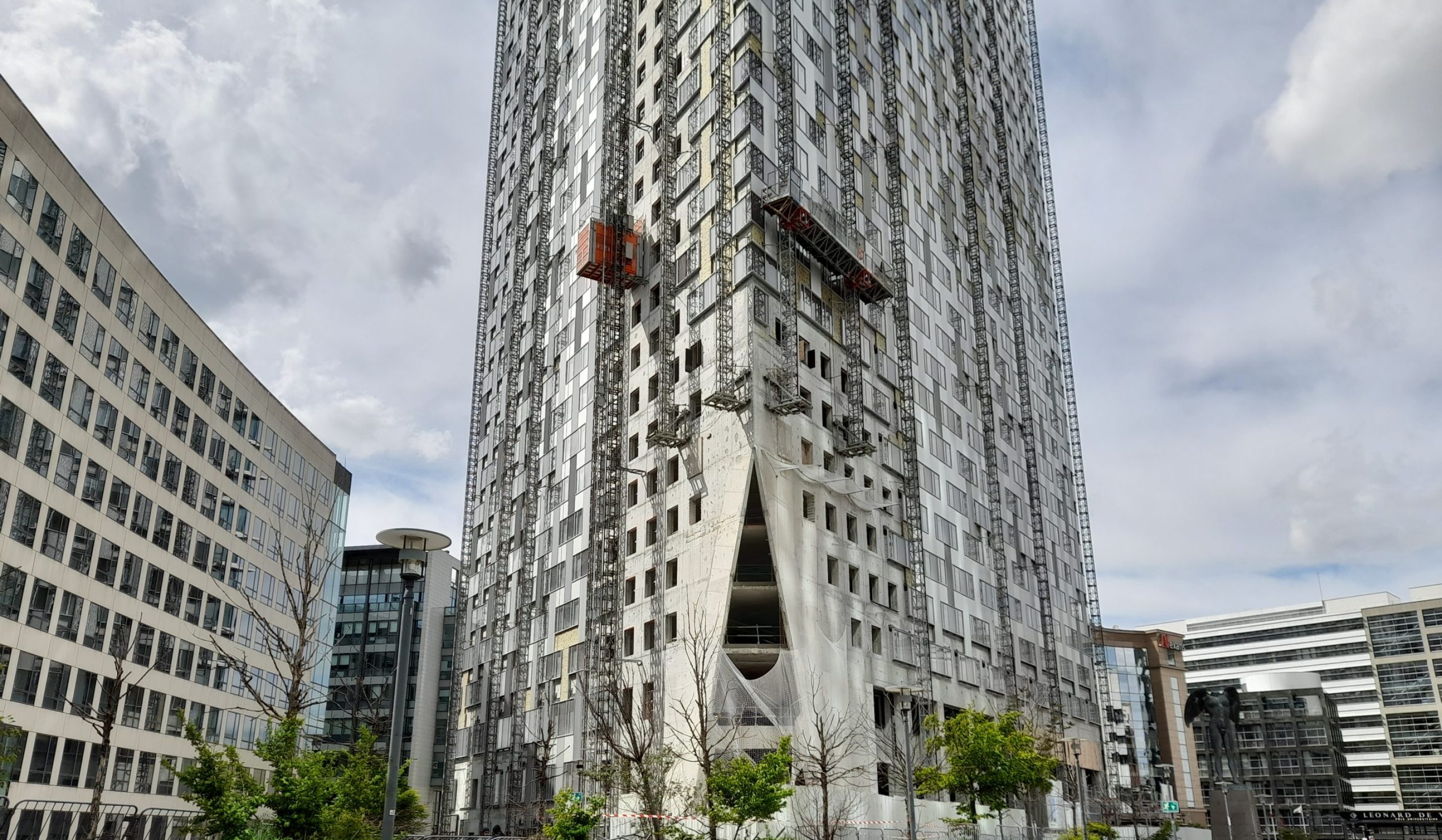
With resources becoming increasingly scarce, transforming existing buildings is becoming a major factor in promoting resource sustainability. In La Défense district in Paris, the Hopen Tower (formerly the Technip Tower, then the Adria Tower, now the Hopen Tower) has been renovated and raised rather than demolished. Camille Carême, structural engineer at setec tpi and project manager (between 2019 and 2023), provides an update on this project from the perspective of resource sobriety.
Renovation and raise: the existing structure as a resource
Rather than demolishing and rebuilding, the project made the most of the structural framework: preserving the shell and a large proportion of the floors — amounting to 50,000 m³ of concrete — reduced waste, disruption and material consumption. The tower was transformed by adding storeys, a lateral extension and a large opening in the façade leading into the lobby.
Optimising load-bearing capacity to minimise the need for reinforcement
The additional storey and the side extension were constructed using a steel structure in order to limit the loads placed on the existing structure and ground settlement. “We sought to minimise all loads as much as possible, to reduce the need for reinforcement,” summarises Camille. The guiding principle adopted was to limit the increase in loads to 5% on the load-bearing structures; beyond that, a recalculation is required, which may lead to structural reinforcement (and therefore more material being added). Accurately calculating the required reinforcement called for phased calculations: in renovation projects, each demolition and reconstruction phase redistributes the loads. The large opening at the base of the tower presented a challenge: the perforated curtain wall contributes to the building’s stability, and this large opening required precisely dimensioned reinforcement to minimise deformation to the remaining structure.
The setec teams had to recalculate a structure that had already been built (despite the absence of all the original design calculations) and carry out extensive investigations: 350 drill holes and core samples, with the support of the setec lerm teams and experts from the Gustav Eiffel University. “In renovation works, we verify the quality of the initial design and construction as much as possible, and there can be surprises,” notes Camille Carême, such as concrete found locally to have almost half its theoretical strength. A better assessment of the existing structure avoids over-reinforcement. New wind tunnel tests have also made it possible to optimise wind loads by around 20% despite the building’s height increase. As for the foundations, reinforcing the ground slab was sufficient, without the need for deep foundations. In terms of reuse, almost all of the raised floors (slabs on jacks) were reused. “Avoiding heavy materials and new construction saves resources.”
Life cycle approach: measure to improve durability
To gain maximum benefit from the analysis of the existing structure, the team fully equipped the tower with monitoring devices (in collaboration with setec lerm and Phimeca) to calibrate the calculation model against the tower’s actual behaviour, particularly in relation to wind loads (accelerations, stresses, etc.), and to explore avenues for predictive maintenance. “Instrumentation means having the means to verify our calculations, to experimentally capture the behaviour of the actual structure, then to detect deviations over time and to intervene earlier and more subtly if necessary — provided we accept monitoring during the building’s operational life.”
This project demonstrates that value can be created by conserving materials: diagnosing, reducing weight, optimising wind loads, controlling stresses and encouraging reuse, in order to intervene as minimally as possible. “Resource saving levers were decided from the start: involving the client and aiming for the minimum necessary reinforcement,” concludes Camille.