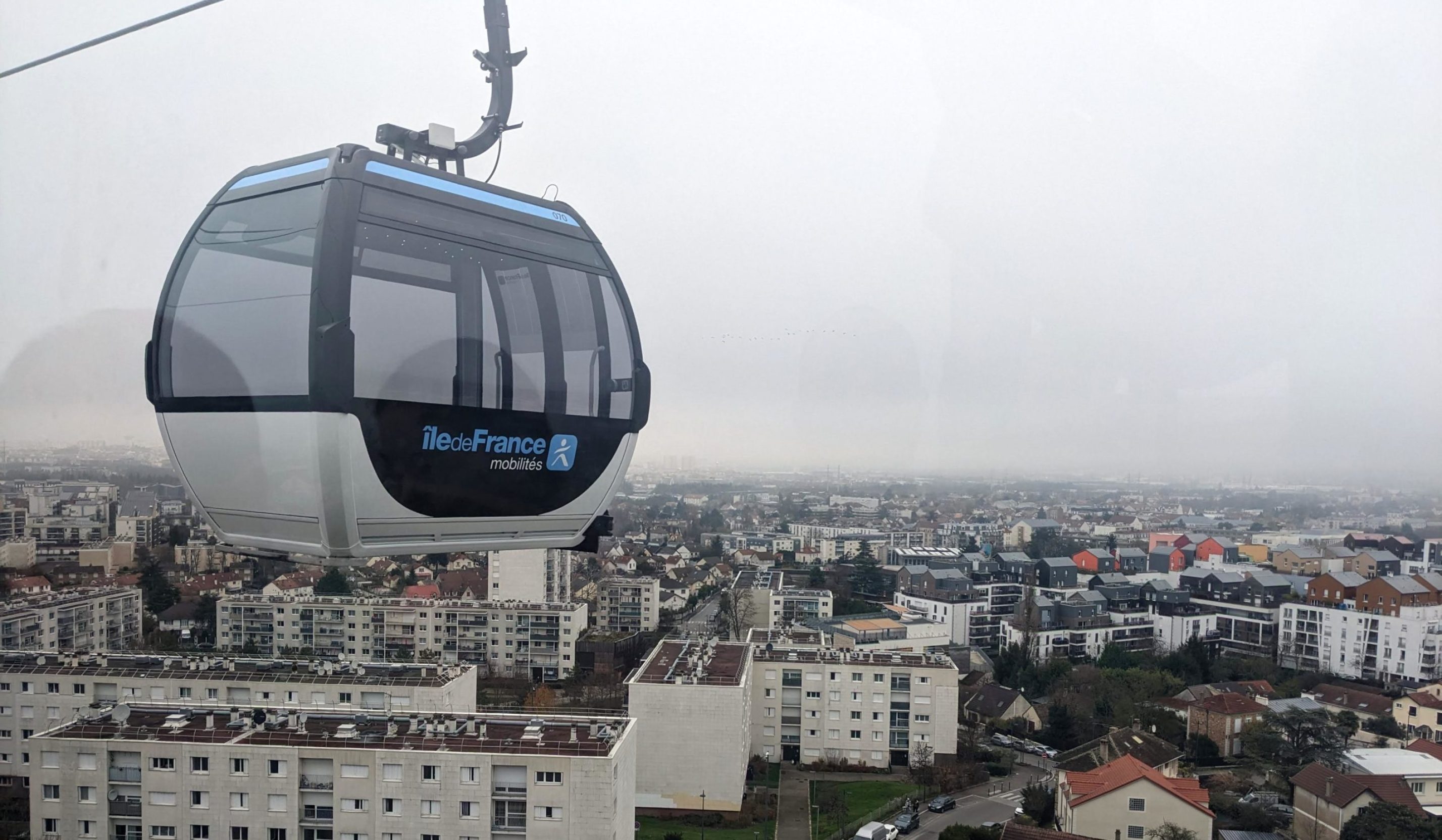
With the launch of Cable 1 on December 13th, 2025, the Île-de-France region will welcome its first urban cable car, an innovative mode of transport designed to connect communities in the Val-de-Marne department. We met with Rémi Stamegna, Project Director at setec organisation, who is working on the Owner’s assistance mission for the construction of Cable 1, and Matthieu Satgé, Project Director at setec its in the Urban Transport Systems department. They look back on nearly a decade of supporting Île-de-France Mobilités, from the preliminary studies and planning of the operation to the implementation of this new line. An interview highlighting the region’s needs, technical choices and main challenges in this innovative project funded by the French government, the Île-de-France region and the Val-de-Marne department.
Understanding the needs of an enclosed territory
The first phase of the project consisted of analysing mobility issues in an area marked by numerous urban barriers: road infrastructure, railways, high-speed rail lines, railway yards, etc. ‘Conventional solutions did not make it possible to open up Limeil-Brévannes, Valenton and Villeneuve-Saint-Georges, nor to provide effective transport links to the main transport lines in the Paris region,’ explains Matthieu Satgé. Rémi Stamegna points out that this area had both average density and high isolation, making buses inefficient over long distances and in a fragmented network. Residents’ journey times were too long, so there was a real expectation for greater everyday convenience. ‘Extending the metro didn’t make sense. We had to come up with a suitable solution.’
Why choose an urban cable car?
The Val-de-Marne department had been exploring the idea of cable transport systems for a long time. This mode of transport allows urban obstacles to be crossed by air, without the need for major engineering structures and with minimal impact on the ground. ‘The cable car is perfectly suited to local demand – around 1,200 passengers per hour per direction – comparable to a high-level service bus but well below that of the metro,’ points out Rémi Stamegna.
Initial feedback from passengers confirms the appeal of this smooth, fast and sustainable solution.
Overcoming the technical challenges of a groundbreaking project in Île-de-France
Installing an aerial infrastructure in a dense urban environment presented a series of challenges rarely encountered on this scale. Matthieu Satgé explains: ‘One of the major challenges was to demonstrate operational safety in order to obtain authorisations: overflight, acoustics, evacuation, fire, etc.’
Risk management, urban integration and coordination with multiple stakeholders required particularly rigorous technical management.
Two main challenges marked the project, as Rémi Stamegna details:
- Acoustics: in an environment already exposed to noise, thanks to a smooth cable and silent motors., dans un environnement déjà exposé au bruit, grâce à un câble lisse et des motorisations silencieuses.
- Universal accessibility: ‘The stations are at ground level, the cabins are enlarged, and the entire system has been designed for everyone to use.’
Technical innovations for comfort and safety
Cable 1 features major technological innovations designed to facilitate operation and improve passenger experience.
Matthieu Satgé highlights operational safety in particular: ‘The design includes a system known as “integrated recovery”, which systematically returns passengers to the station in the event of a failure, avoiding vertical evacuations as much as possible. ‘ He also highlights the integration of the cable car into the Paris public transport network, on an equal footing with other modes of transport: passenger information, intercom, video surveillance, public address system, etc., not only in passenger areas but also in the 105 cabins that travel along the line. Acoustic performance, already mentioned, is also the result of advanced innovation, thanks to the carrier-tractor cable technology combining metal strands and synthetic profiles.
Sustainable mobility in harmony with the environment
The cable car is 100% electric and produces zero greenhouse gas emissions during operation. The energy consumption per passenger is lower than that of other modes of transport, while the fact that it can be used in conjunction with other modes of transport – bus, bicycle, footpaths – makes it a perfect example of an Engineers & Citizens project. ‘ It encourages modal shift thanks to reduced journey times and the intermodality offered at each station (bus, bicycle),’ says Matthieu Satgé. Environmental integration was also a major challenge, as Rémi Stamegna points out: ‘The line crosses a future urban park. Cutting down trees, such as in mountainous areas, was out of the question. The route was adjusted and extensive fire studies were carried out above the wooded areas.’
A method of transport at the heart of national and European initiatives
Cable 1 is part of the recent trend of urban cable cars in France, following Grenoble, Brest, Toulouse and Ajaccio. ‘Discussions are underway for a Cable 2 between Vélizy and Boulogne to relieve congestion on the RN118,’ says Matthieu Satgé.
With a length of 4.5 km and 5 stations, it is one of the most ambitious urban cable car projects in Europe. ‘Cable 1 is a truly structuring transport line, which is rare,’ points out Rémi Stamegna.
A source of pride and human motivation
Beyond the technical aspects, the project relies on a strong human motivation. ‘I am proud of the launch, its success with residents, and our close collaboration with our client, Île-de-France Mobilités,’ says Rémi Stamegna. A dozen setec employees were involved in this project, which was delivered on time, to serve a region undergoing rapid transformation.