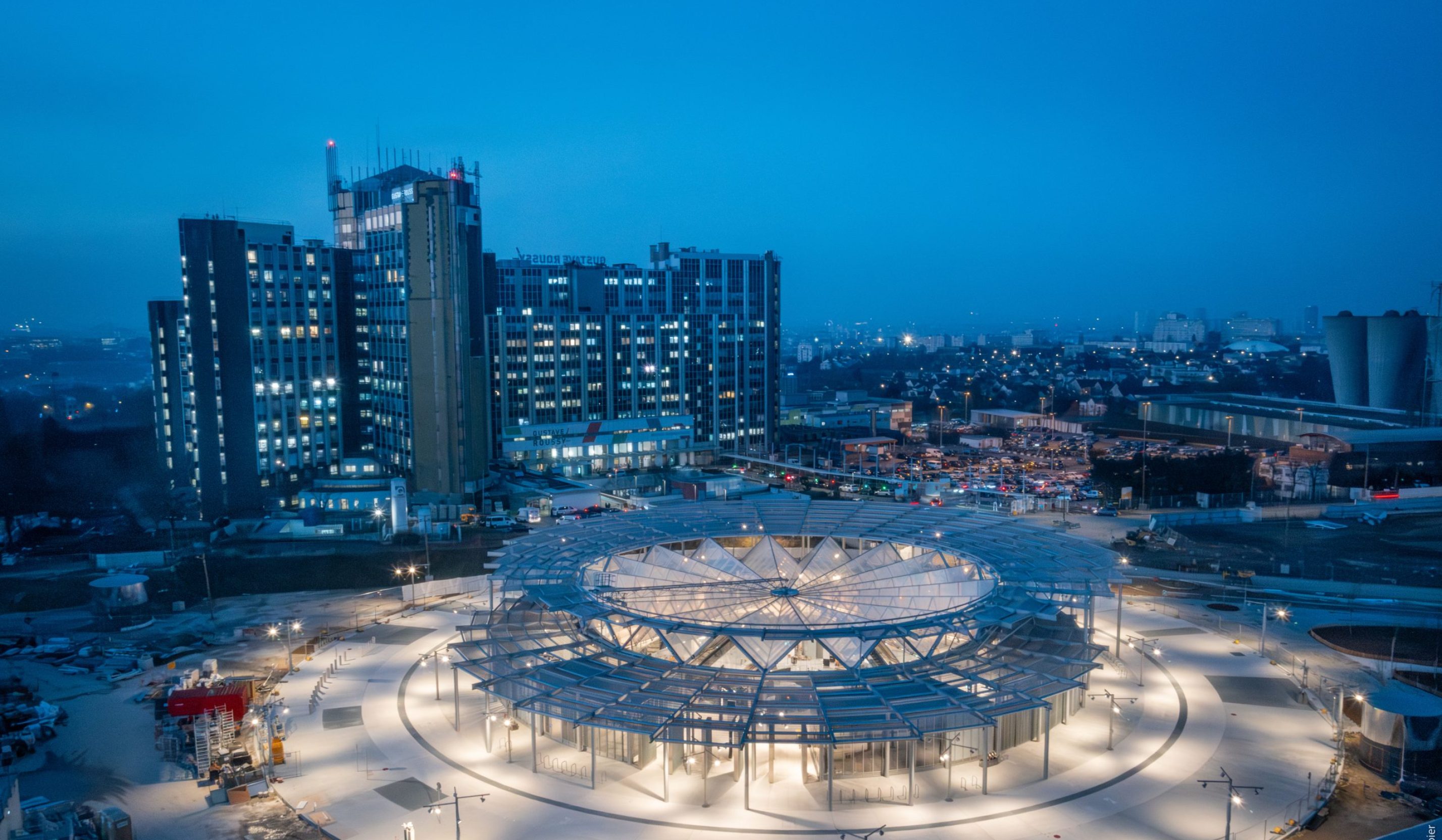
Since 2006, the French National Engineering Grand Prix (GPNI) honours engineers who design innovative solutions in the field of industry or design. The teams at setec had the privilege of winning the GPNI 2025 award on the 21st of October at Meet’Ingé for the design of a major project: the Villejuif Gustave Roussy railway station.
A commitment of more than 10 years for setec employees from different companies, who worked hand in hand to ensure the success of this large-scale project. The engineering teams spent a total of 300,000 hours on the project and monitoring the works, representing the equivalent of 130 years of engineering works. More than 60 people have worked on this project, some of them from day one in 2013 until today. We met with Hervé Tourlet, Project Manager, and Adeline Atramont, Engineer both from setec tpi, the project’s lead company, Jean-Pierre Nony, Design Director, Camille Picq, Design Project Manager, and Juliette Marchal, Design & Construction Project Manager, all three from setec bâtiment, and Gilles Chapron from setec terrasol.
An essential project for mobility in the Greater Paris region
A key factor in the development of carbon-free mobility and improving access to different areas in the Île-de-France region, the Grand Paris Express project has created four new transport lines. The Gustave Roussy station in Villejuif connects metro lines 14 and 15 South and can handle up to 100,000 passengers per day. It connects the city, the Hautes Bruyères park and the Gustave Roussy Institute, Europe’s leading cancer research centre. setec and the Dominique Perrault Architect agency have combined their expertise to deliver this iconic metropolitan network project. A project that was not without its constraints and challenges from the outset…
Tackling technical and architectural challenges
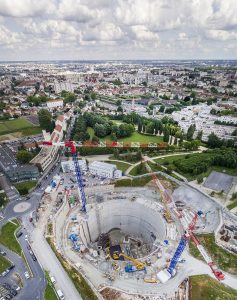
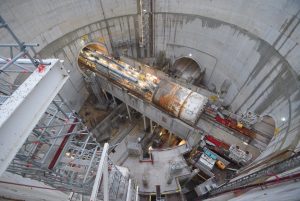
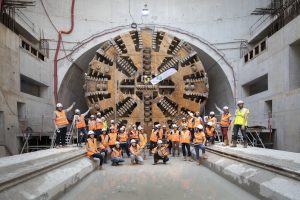
The result of a collaboration between setec and Dominique Perrault Architecture, the station stands out thanks to its monumental shaft, measuring 63 metres in diameter and 50 metres deep, and its four vaulted tunnels housing the platforms for metro lines 14 and 15. To overcome the restrictions of the site, the teams came up with innovative solutions: crossing the L14 tunnel boring machine on a bridge, audacious supports, unique supports for the monumental escalators and a transparent ETFE cable roof. “The Hautes Bruyères park is located on a hill. Our team optimised the routes of metro lines 14 and 15 to make them perpendicular and raise the level of the platforms as high as possible, ‘says Hervé Tourlet, engineer at setec tpi and project manager. “We then had to implement some ingenious structural solutions.”
The smoke extraction systems in this 50-metre-deep shaft, which is used by members of the public, have been rigorously tested during the design phase using digital simulations, guaranteeing their effectiveness in real-life situations.
“This is a truly unique station due to its extraordinary dimensions, its depth, and the multitude of geotechnical issues that had to be dealt with during the design and monitoring of the works,” says Gilles Chapron of setec terrasol. “The four underground caverns dug into plastic clay and marl gave us quite a bit of trouble, particularly during the execution study phase, and monitoring them was particularly intense for our project manager Anthony Bachelier. The design of the shaft (temporary shell made of thin diaphragm walls and reinforced concrete counter-shell) is a truly innovative idea and, despite its apparent complexity, has proven to be very effective and well suited to the context.”
A bioclimatic, sustainable station with controlled environmental impact
Building a deep underground station is a technical, architectural and functional challenge.
The bioclimatic design of the station drastically reduces air conditioning and ventilation requirements, thereby optimising energy consumption. Heat recovered from the technical rooms is used to heat public and commercial areas, illustrating a virtuous and environmentally friendly approach.
Adeline Atramont, design and construction engineer at setec tpi, reaffirms this commitment to sustainable and responsible construction: “Optimising the shaft support, reducing the volume of excavated material and using lightweight support methods have helped to limit the project’s carbon footprint.”
User safety and comfort
Passenger safety is ensured by fire-resistant compartments that encapsulate the platforms, limiting the need for smoke extraction and providing immediate protection in the event of a fire. The 20-metre suspended staircases facilitate mobility and ensure smooth traffic flow to the shops and forecourt.
What struck you the most about this project
“The complexity of this project, which uniquely combines heavy underground works with the ambitious architecture of a public building, all combined with the more industrial nature of two different metro systems!” says Hervé Tourlet.
What impressed Adeline Atramont most was “the depth of contributions made by each profession. The architects profoundly transformed the project: they moved from an initial design with solid floors and vertical circulation stopping at each floor to the bold idea of a large central void crossed by monumental staircases. The construction company set an incredible pace for digging the shaft, which was necessary to meet the deadline for the passage of the Line 14 tunnel boring machine and avoid any delays on this strategic line for the Olympic Games.”
Juliette Marchal highlights “the number of people and areas of expertise involved in this operation, all of which contributed to its success.”
“The combination of ideas and skills which, when brought together, made it possible to overcome difficulties by serving an unconditional architectural vision with symbolic significance,” concludes Gilles Chapron.
What does this National Engineering Grand Prix award mean to you?
For Hervé Tourlet, this award is “the result of a, entire team’s determination and ingenuity, with successful handovers thanks to the setec group spirit’.
Jean-Pierre Nony from setec bâtiment sees it as “ the recognition of a technical achievement in the service of architectural ambition and the functional efficiency of the station.”
Finally, for Gilles Chapron, this award illustrates his “pride in having participated in the creation of a major project, which I myself use very frequently, and on these occasions, I can see how useful and transformative it is for the city it serves.”
A project that combines expertise, sustainability and performance in the service of urban development and the mobility of tomorrow. Congratulations to all the teams involved in this project!
Copyright pictures : Anne-Claude Barbier